
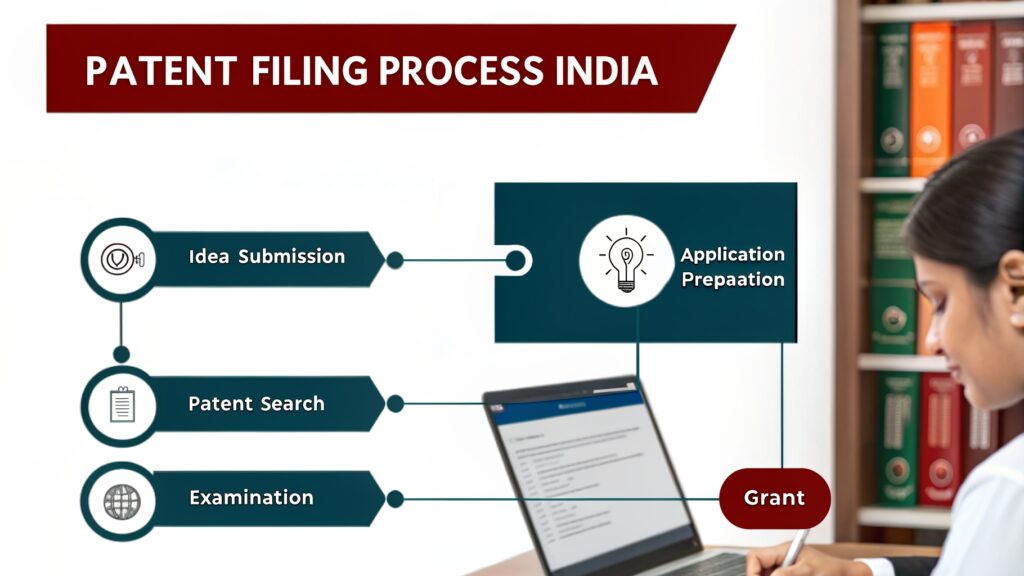
Patent Filing is a legal process that protects your invention from unauthorized use by granting exclusive rights to the inventor for a specified period. In India, patent filing is regulated under the Indian Patent Act, 1970 and administered by the Indian Patent Office (IPO).
Why is Patent Filing Important?
- Provides exclusive legal rights to the inventor
- Protects your invention from copying or misuse
- Enhances the commercial value of your invention
- Increases business credibility and monetary benefits
- Helps in licensing and international protection
Who Can Apply for a Patent in India?
- Individual Inventors
- Startups
- Small Entities
- Companies or LLPs
- Joint Applicants
Types of Patent Applications in India
| Type of Patent Application | Purpose |
|---|---|
| Provisional Application | Temporary protection before filing the complete specification |
| Complete Specification | Full technical details of the invention |
| Convention Application | Claiming priority from a foreign application |
| PCT National Phase Application | International patent application under the Patent Cooperation Treaty (PCT) |
| Divisional Application | Filed when an invention contains more than one invention |
| Patent of Addition | For improvements or modifications of the original patent |
Step-by-Step Patent Filing Process in India
- Patent Search: Identify if your invention is novel or already patented.
- Drafting the Patent Specification:
- Provisional Specification (If invention is under development)
- Complete Specification (Detailed invention description, claims, and abstract)
- Filing the Patent Application: File the application online or offline with Form 1 (Patent Application Form).
- Publication of Patent Application: The application is published in the Patent Journal after 18 months from the filing date.
- Request for Examination (Form 18): A request must be made within 48 months from the filing date.
- Objection Reply & Hearing: Submit replies to any objections raised by the examiner.
- Grant of Patent: If the examiner is satisfied, the patent will be granted and published in the official journal.
- Patent Renewal: A patent is valid for 20 years from the filing date and must be renewed annually from the 3rd year onwards.

Timeframe for Patent Filing
| Process Stage | Time Required |
|---|---|
| Patent Search | 3-10 Working Days |
| Provisional Filing | 2-3 Working Days |
| Complete Specification Filing | 7-10 Working Days |
| Publication | 18 Months (Automatic) |
| Examination Report | 12-18 Months |
| Grant of Patent | 3-5 Years |
Fee Structure for Patent Filing in India (2025)
| Service | Individuals/Startups | Small Entities | Companies |
|---|---|---|---|
| Provisional Application Filing | ₹1,600 (Online) | ₹4,000 (Online) | ₹8,000 (Online) |
| Complete Specification Filing | ₹1,600 (Online) | ₹4,000 (Online) | ₹8,000 (Online) |
| Request for Examination | ₹4,000 | ₹10,000 | ₹20,000 |
Why Choose Us for Patent Filing?
- Expert Patent Attorneys
- Affordable & Transparent Pricing
- Fast & Hassle-Free Online Process
- End-to-End Legal Support
- Free Patent Search Consultation
- International Patent Filing Support
Our Patent Services Include:
- ✔ Patent Search & Report
- ✔ Patent Drafting & Filing
- ✔ Objection Reply & Hearing
- ✔ Patent Opposition & Litigation
- ✔ Patent Renewal & Licensing
- ✔ International Patent Filing (PCT)
Contact Us Today!
Protect your innovative ideas with our expert patent filing services.
Would you like to book a free consultation or get a price quote?
I really appreciate your efforts put on this post. Thanks for sharing this